Why Everyone Gets Renamed When the Emperor Dies
A note on court titles in Tia Shan's palace novels — what they mean, why they matter, and how accession reshuffles everything.
I get this question more than any other from English-language readers: “Wait — is the Crown Princess the same as the Empress?” Or: “What is a Liangdi, and why does she matter?”
After answering it for the fifth time in a row, I realized I had been writing the same long email over and over. So I wrote this guide instead. Bookmark it. Come back to it whenever a title trips you up. It covers The Emperor’s Caged Bride, The Cloud Beside the Moon, and The Emperor’s Last Lie, and it is designed to be read before, during, or after any of them — no spoilers.
— Tia
In palace stories, a title is never decoration. It decides who eats first, who kneels to whom, whose child counts as legitimate, and whose death gets mourned in public. If you have ever read a scene where a character gets promoted and thought why does everyone look so nervous about it — this is what you need to know.
The books borrow from Chinese imperial history but invent their own courts and imagined dynasties. Treat what follows as a map to the stories, not a history textbook.
Two things to keep in mind before you start:
- Two separate households exist at the same time. The Emperor runs the main palace; the Crown Prince runs the Eastern Palace. Each has its own wife, consorts, servants, and rules.
- Accession reshuffles everything. When the Crown Prince becomes Emperor, his Eastern Palace women are absorbed into the imperial harem, and every single one of them gets a new title — or loses the one she had.
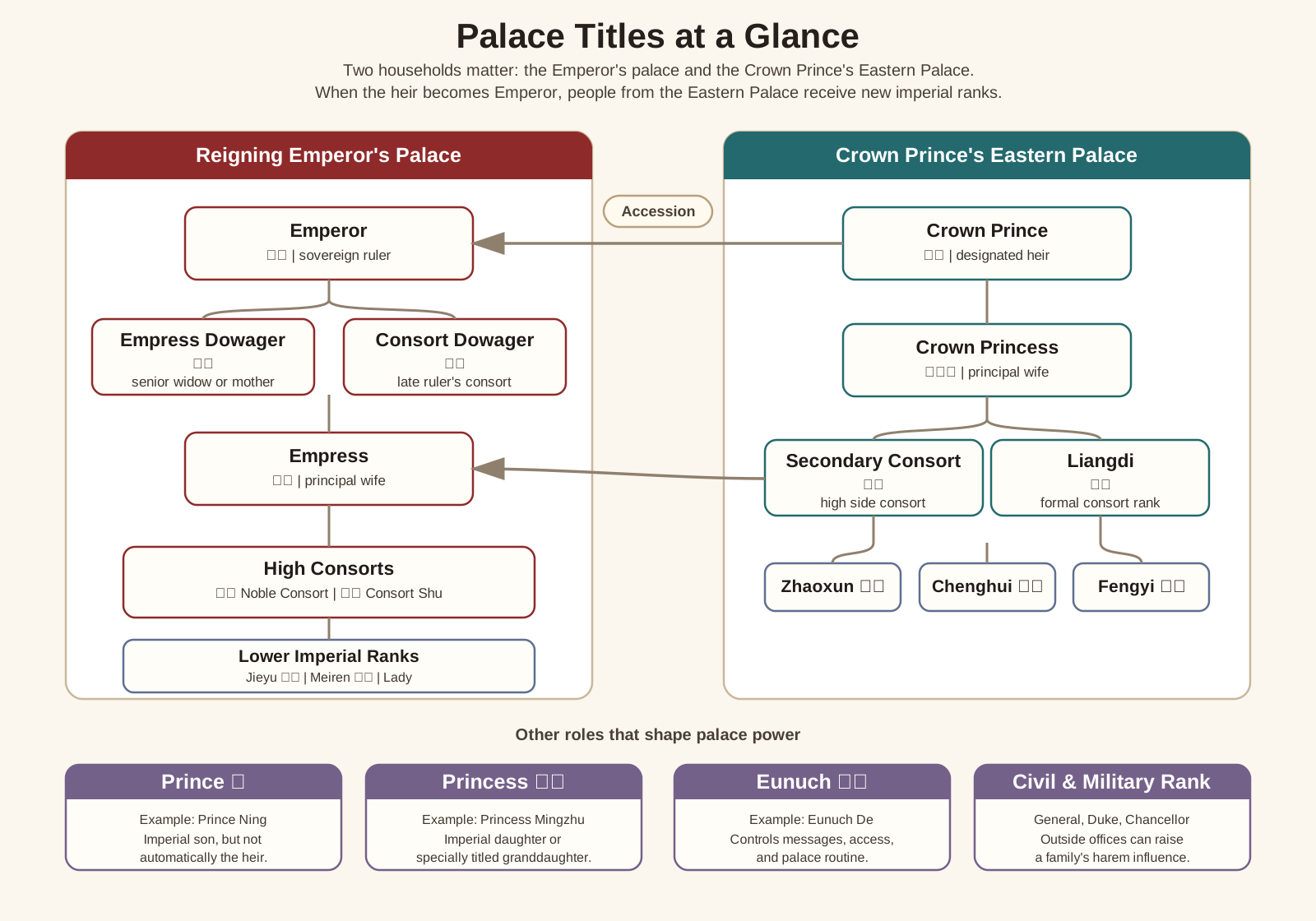
The Emperor’s Court
These ranks belong to the reigning Emperor’s world.
| Chinese | English in the books | In practice |
|---|---|---|
| 皇帝 | Emperor | Everyone else’s rank exists because he allows it. |
| 皇后 | Empress | His principal wife. She manages the inner palace and outranks every consort — on paper. In reality, she needs children, allies, and luck. |
| 太后 | Empress Dowager | The previous Emperor’s wife, or the reigning Emperor’s honored mother figure. Seniority and filial duty make her difficult to touch, but not impossible to isolate. |
| 太妃 | Consort Dowager | A former Emperor’s consort who was not senior enough to become Empress Dowager. She keeps her dignity but little else. |
| 皇贵妃 | Imperial Noble Consort | A very high consort title. In The Emperor’s Last Lie, Imperial Noble Consort Lin’s rank makes her shadow difficult for the harem to escape. |
| 贵妃 | Noble Consort | One of the highest consort ranks below Empress. A Noble Consort with a powerful father is a political problem, not just a romantic rival. |
| 妃 | Consort | A formal consort rank. Consort Rong, Consort Wan, and Consort Zhuang show how much favor, danger, and private grief can sit under the same English word. |
| 淑妃 | Consort Shu | A high consort rank. In these books, reaching Consort Shu means a woman has real standing in the harem. |
| 昭仪 | Zhaoyi | A high harem rank below Consort. In The Emperor’s Last Lie, Zhaoyi Rong’s promotion changes the air in the room before anyone has time to object. |
| 婕妤 | Jieyu | A mid-level harem rank. The translation keeps the Chinese term because there is no clean English equivalent. |
| 贵人 | Noble Lady | A lower consort rank. Noble Lady Feng’s fate in The Emperor’s Last Lie shows how little protection beauty and brief favor can offer. |
| 常在 | First Attendant | A lower harem title. A First Attendant can still become politically useful if someone powerful decides she resembles the right woman. |
| 美人 | Meiren | A lower consort rank — literally “beauty.” |
The Eastern Palace
These ranks belong to the Crown Prince’s household. They mirror the Emperor’s harem but sit one level below it. When the Crown Prince ascends, every woman here gets reassigned into the imperial system above.
| Chinese | English in the books | In practice |
|---|---|---|
| 太子 | Crown Prince | The named heir. He has his own residence, servants, consorts, and household budget. |
| 太子妃 | Crown Princess | His principal wife. If he takes the throne, she is expected to become Empress. |
| 侧妃 | Secondary Consort | A high-ranking side wife — below the Crown Princess, above everyone else. Ruan Yueying holds this title in The Cloud Beside the Moon, and the demotion from intended Crown Princess to Secondary Consort is the wound that drives the novel. |
| 良娣 | Liangdi | A formal consort rank within the Eastern Palace. Below the principal wife and Secondary Consort, but still part of the official household. |
| 昭训 | Zhaoxun | A lower Eastern Palace rank. Minor on paper, but pregnancy or patronage can change that fast. |
| 承徽 | Chenghui | A lower Eastern Palace rank in The Emperor’s Caged Bride. Wei Su is considered too low-born to start even here. |
| 奉仪 | Fengyi | The bottom rung of the Eastern Palace in The Emperor’s Caged Bride. Wei Su is first placed at this rank as Lady Wei. |
The Imperial Family
These are not harem ranks but family positions — blood or marriage ties to the throne.
| Chinese | English in the books | In practice |
|---|---|---|
| 王 | Prince (e.g. Prince Ning) | A titled imperial prince. Royal by blood, but not the heir unless formally named. |
| 王妃 | Prince’s Consort | The principal wife of a titled prince. |
| 世子 | Heir Apparent | The named heir of a princely household — not the same as heir to the empire. |
| 公主 | Princess | An imperial daughter, or by special favor an imperial granddaughter. Chan’er receives the title Princess Mingzhu. |
| 皇长子 | Eldest Prince | The Emperor’s eldest son. Being first-born matters, but it does not guarantee the crown. |
| 皇孙 | Crown Grandson | A grandson in the Crown Prince’s line. |
People Who Keep the Palace Running
These roles carry no noble rank, but the people in them see everything.
| Role | Where it appears | What it means |
|---|---|---|
| 公公 / 太监 — Eunuch | Eunuch De in The Emperor’s Caged Bride | Senior eunuchs control doors, messages, and schedules. Eunuch De stands between the Emperor’s private feelings and his public commands. |
| 宫女 — Palace maid | Wei Su starts as a lamp-tending maid; Rong-niang serves Yueying | A maid has no rank, but proximity is its own currency. Rong-niang runs Yueying’s intelligence from inside the servants’ quarters. |
| 太医 — Imperial physician | Physicians appear around childbirth, illness, and poisoning | Medical access decides whether a secret stays hidden, whether a pregnancy survives, and who gets blamed when it doesn’t. |
How the Outer Court Shapes the Inner Palace
A woman’s rank often rises or falls because of what her father or grandfather has done outside the palace walls.
| Title | Where it appears | Why it matters |
|---|---|---|
| Grand Chancellor | Ruan Yueying’s grandfather in The Cloud Beside the Moon | Her elite birth is why losing the Crown Princess seat feels like a public humiliation for the entire Ruan clan, not just a private heartbreak. |
| General / First-rank Duke | Shangguan Zhan in The Emperor’s Caged Bride | Military victory turns into court influence. His battlefield success makes his daughter Shangguan Feiqiong a serious rival to the Empress. |
| Cavalry General | Wei Ying (Wei Su’s brother) in The Emperor’s Caged Bride | A low-born woman becomes easier to promote once her family gains military value. His appointment clears the path for Wei Su’s rise. |
The Eastern Palace Is a Court in Miniature
The Eastern Palace is not a waiting room. It is the Crown Prince’s fully functioning court: principal wife, side consorts, lower-ranked women, maids, eunuchs, physicians, rituals, jealousies, and succession anxieties — all compressed into a smaller space with a younger, less experienced man at the center.
“Secondary Consort” is not a throwaway label. Ruan Yueying in The Cloud Beside the Moon was meant to be Crown Princess, so the demotion is a humiliation — but she is still high enough to bear the heir’s child and manage household affairs. The title wounds her pride without erasing her power.
The lower ranks matter too. Hu Mianmian and Wen Shuer both hold the Liangdi rank; Shen Luoning is a Zhaoxun. They are not simply “mistresses.” Each has a formal position inside the household, with servants, allowances, and expectations — and each has something to gain or lose if the Crown Prince ascends.
Accession: When Everyone Gets Renamed
One of the biggest shifts in these novels is accession: the Crown Prince becomes Emperor, or one Emperor dies and another takes the throne. The Eastern Palace can dissolve, and every woman connected to power may be reassigned under new titles.
Here is how it works in general:
- The Crown Princess is expected to become Empress.
- The previous Emperor’s wife may become Empress Dowager, protected by seniority and filial duty.
- Side consorts and lower-ranked women are slotted into the imperial harem — some rise, some stay where they are, and some discover that a new reign has no place for them.
- Even the dead can be renamed. A posthumous title settles the official record: who mattered, and in what order.
The novels stage this transition in different ways, and the reshuffle is where private grudges and political debts come due. Watch who gets promoted, who gets skipped, and who gets a title that looks generous but quietly shuts a door.
Characters and Their Starting Titles
The Emperor’s Caged Bride
| Character | Title when you meet them | Who they are |
|---|---|---|
| The Emperor (Li) | Crown Prince | The heir to the throne — and the man A-Jiao is forced to marry. |
| Cui Jiao (A-Jiao) | Crown Princess (replacing her dead cousin A-Shuo) | She steps into a dead woman’s seat and spends the novel trying to be seen as herself. |
| Cui A-Shuo | Crown Princess (deceased before the story begins) | She never appears alive, but her title haunts every page. A-Jiao is always measured against her. |
| Empress Dowager Cui | Empress Dowager | The Cui clan’s strongest shield. Her authority comes from rank, seniority, and the fact that the Emperor is her adopted son. |
| Prince Ning (Fifth Prince) | Prince Ning | A-Jiao’s childhood sweetheart. Royal but not the heir — which gives him status without security. |
| Consort Xu | Consort Xu | Prince Ning’s mother. Her dignity is tied to her son’s standing at court. |
| Wei Su | Palace maid (lamp-tender) | A low-born servant who resembles the dead A-Shuo. Her brother Wei Ying’s military career will matter. |
| Shangguan Feiqiong | Noble Consort Shangguan | High rank plus a victorious father makes her a direct political rival to the Empress. |
| Wang’er (Li Wang) | Eldest Prince | The Empress’s son — the obvious candidate for Crown Prince, but “obvious” is not the same as secure. |
| Eunuch De | Chief eunuch | He controls the door between what the Emperor feels and what the Emperor orders. |
The Cloud Beside the Moon
| Character | Title when you meet them | Who they are |
|---|---|---|
| Gu Ming | Crown Prince | The heir. Emotionally immature, with consequences that ripple through every woman in his household. |
| Ruan Yueying | Secondary Consort (was meant to be Crown Princess) | A chancellor’s granddaughter forced into the wrong seat. The demotion is the wound that shapes the novel. |
| Qin Yunnong | Crown Princess | The woman who holds the seat Yueying was supposed to have. A fifth-rank official’s daughter — her smile hides more than it shows. |
| Hu Mianmian | Liangdi | Yueying’s closest friend. Devoted to the Crown Prince in a way that worries everyone around her. |
| Wen Shuer | Liangdi | Gentle and cautious. She and Yueying grow close inside the Eastern Palace. |
| Shen Luoning | Zhaoxun | A lower-ranked Eastern Palace consort. Minor in rank, but rank is not the only thing that matters here. |
| Chan’er | Princess Mingzhu | Gu Ming’s spirited daughter, given a princess title by her grandparents as a mark of special favor. |
| Gu Zhiyi | Crown Grandson | Qin Yunnong’s son. His legitimacy comes from being the Crown Princess’s child. |
| Rong-niang | Personal maid | Yueying’s maid since childhood. No title, but Yueying trusts her completely. |
The Emperor’s Last Lie
| Character | Title when you meet them | Who they are |
|---|---|---|
| Ye Changning / Tong Yuer | Second Attendant Ye | The heroine, brought from Anyuan Temple into the imperial harem after seven years of survival. |
| Li Chengmu | Emperor | The ruler who once loved Changning as Yuer, now trying to secure her future before his old poisoning catches up with him. |
| Former Crown Prince Li Chengyu | Former Crown Prince | Changning’s former husband. His failed rebellion is the public wound behind the novel’s private grief. |
| Imperial Noble Consort Lin | Imperial Noble Consort (deceased before the story begins) | The dead favorite whose shadow shapes how the harem sees Changning. |
| Noble Consort Yi / Hou Yuanying | Noble Consort Yi | The highest-ranking woman in the palace when Changning enters; her Hou family power makes her politically exposed. |
| Consort Rong / Jiang Xiaoqing | Zhaoyi Rong, then Consort Rong | The Emperor’s cousin and a feared presence in the harem. Her early promotion tells everyone who currently has favor. |
| Consort Wan / Xiao Qiuyun | Consort Wan | A frail-seeming consort whose past ties her to grief, motherhood, and the dead Crown Prince. |
| Concubine Shen / Shen Yuhuan | Concubine Shen | A quiet palace woman whose private grief becomes one of the novel’s darker harem threads. |
| Noble Lady Feng | Noble Lady | Her death opens the novel and shows how dangerous even brief favor can become. |
| Yinyuan | Palace maid | Changning’s maid: sharp, practical, and close enough to see what rank cannot explain. |
A Quick Way to Read the Titles
When you hit a title you don’t recognize, ask four questions:
- Which household? Does this person belong to the Emperor’s palace or the Crown Prince’s Eastern Palace?
- Which generation? Is this a current wife/consort, or a dowager from the previous reign?
- What level? Is she the principal wife, a high consort, or a lower-ranked consort?
- Before or after accession? Has the Crown Prince already become Emperor?
Crown Princess and Empress are parallel positions — one becomes the other at accession. Secondary Consort, Liangdi, Zhaoxun, Chenghui, and Fengyi belong to the heir’s household. Imperial Noble Consort, Noble Consort, Consort, Consort Shu, Zhaoyi, Jieyu, Noble Lady, First Attendant, Second Attendant, and Meiren belong to the reigning Emperor’s harem.
But rank only tells you where someone stands. The story tells you what happens when the ground shifts.
✦
If this guide helped, the stories are here:
→ The Emperor’s Caged Bride A-Jiao steps into a dead woman’s seat, and spends the novel trying to be seen as herself.
→ The Cloud Beside the Moon Yueying was meant to be Crown Princess. She becomes Secondary Consort instead — and spends twenty years making them regret it.
→ The Emperor’s Last Lie Ye Changning is dragged back into the palace by the Emperor who loved, ruined, and lied to protect her.
A free story for new readers
The Empress He Could Not Keep — a complete short story
of empire, obsession, and the impossible return.
Yours when you join the reader list.