What Makes a Morally Grey Heroine Compelling?
A-Jiao, Yueying, and Changning show how duty, revenge, and survival can leave a heroine with choices that cannot be washed clean.
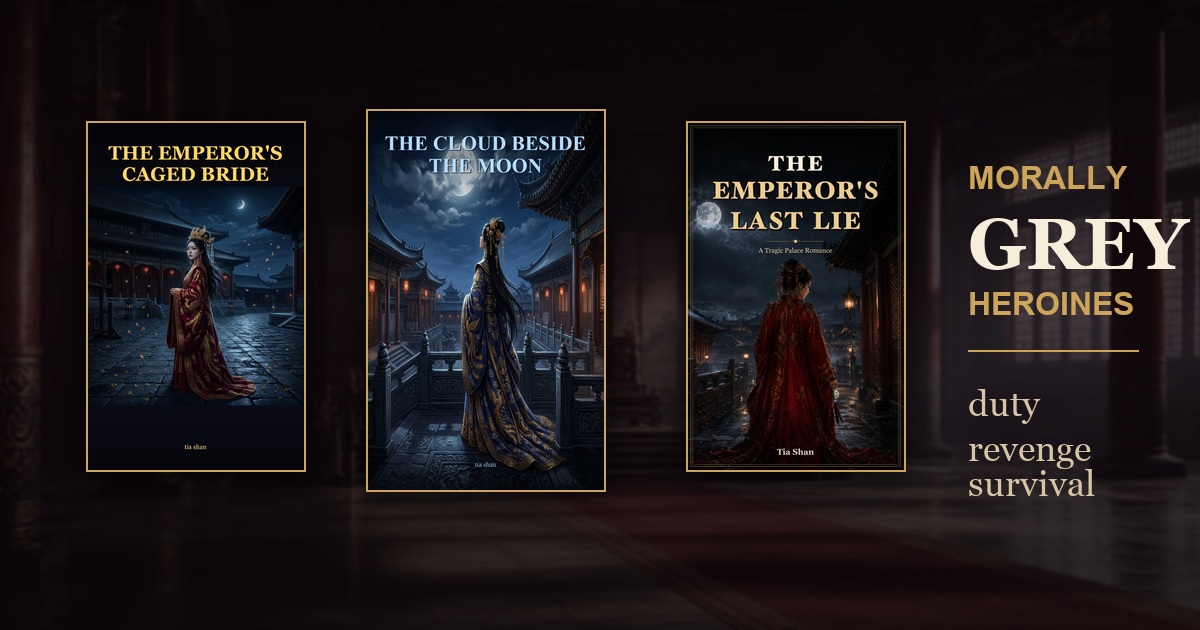
When I call a heroine morally grey, I do not mean she has a sharp tongue, wears dark colors, and looks good walking away from consequences. That can be entertaining, but it is not the thing that keeps me writing women like A-Jiao, Yueying, and Changning. What interests me is the moment a reader can understand a woman’s choices without being able to make those choices clean. Palace fiction is especially good at creating that moment, because the heroine is never choosing in a vacuum. She is choosing under family duty, rank, fear, grief, pregnancy, reputation, and survival. Light spoilers: emotional shape, not final reveals.
Moral greyness is not an aesthetic. It is what is left after choices that cannot be washed clean.
Moral greyness is not a pose
A compelling morally grey heroine needs pressure and accountability. Without pressure, she is simply a villain the book is trying to soften. Without accountability, she becomes a victim the book is afraid to let grow teeth. The interesting ground lies between the two: the story shows why she acted as she did, then refuses to pretend understanding is innocence.
That is why I return so often to palace settings. In a palace, a woman can make a terrible choice and still be responding to a terrible structure. The harem rewards silence, calculation, and performance. The clan turns daughters into treaty paper. Marriage is succession, rank, heirs, and political debt. I wrote more about that architecture in Why Palace Romance Needs Tragedy, but the same logic applies to character. The palace does not make women pure. It gives them incentives to survive in ways they may not be able to forgive.
A-Jiao: duty as a hiding place
A-Jiao’s moral greyness is the quietest, which may be why it hurts me most.
In The Emperor’s Caged Bride, she is sixteen when her family sends her into the palace to take her dead cousin’s place as bride. She does not want the marriage. She loves someone else. She even says no, at first. But A-Jiao has been raised inside a family grammar where legitimate daughters are answers to political problems.
Her grey is not grand harm. It is that she learns to make obedience look like virtue, then hides inside it until the hiding becomes its own kind of damage.
She imitates the dead woman she is supposed to replace. She swallows words that should have been spoken. She lets family duty explain choices that wound herself, Prince Ning (the man she loved), the Emperor, and eventually the child whose future becomes the last thing she can still arrange. None of this makes her simply cruel. It makes her frighteningly human. She chooses safety over honesty because honesty has no visible reward in her world.
That is the difficult part of A-Jiao. The reader can see how young she is and how little room she has. Still, the story keeps returning to the cost of silence. Passivity is not harmless because it looks soft. A-Jiao is used by almost everyone, and then, to protect what remains, she learns to use the same machinery in smaller, sadder ways.
Her grey is passivity wearing the costume of duty.
Yueying: revenge with a ledger
Yueying, in The Cloud Beside the Moon, is a sharper case.
She begins with a wound she did not choose. She enters the Eastern Palace wanting distance, dignity, and a quiet life. She does not want the Crown Prince’s love or the center of the room. Her moral clarity is almost bracing: she sees the absurdity of women being made to orbit one man’s attention, and refuses to romanticize it.
Then the palace turns friendship into risk, grief into evidence, and a young woman’s death into a door Yueying cannot walk away from.
Yueying’s revenge is compelling because it begins from a place the reader can honor. She is not wrong to want justice. She is not wrong to recognize that gentleness, in her world, is often another word for being available to be harmed. The problem is that revenge does not stay inside its original moral border. Once Yueying starts counting debts, every person near her becomes part of the ledger.
This is where a morally grey heroine becomes more than a fantasy of retaliation. Yueying can be right about the wound and wrong about what the wound permits. She can protect one friend while endangering another. She can win rank, authority, and the outward shape of justice, yet find that victory has taught her a language too cold to unlearn.
That is why I resist calling Yueying simply “strong.” Strong is too clean a word for her. She is proud, funny, loyal, merciless, self-judging, and sometimes unfair. Her most devastating moments are the ones where she knows what revenge has made of her and keeps walking anyway.
Her grey is calculated revenge becoming indistinguishable from cruelty.
Changning: armor mistaken for safety
Changning’s greyness in The Emperor’s Last Lie comes from survival after the original disaster has already happened.
By the time the novel opens, she has lost a family, a name, a first marriage, and seven years of ordinary life. She has learned how to live as a ghost at Anyuan Temple. When Li Chengmu drags her back into the palace, the court sees a low-ranked substitute who resembles a dead favorite. Changning knows the situation is more dangerous, and that softness has cost her too much.
Changning’s armor is intelligent: funny, cutting, observant, and often necessary. She survives by refusing to be absorbed into someone else’s memory. She resists being called by the wrong name. She notices harem lies because she has spent years being made into one. The reader wants that armor for her.
But armor is still armor. It keeps blows out by keeping touch out as well.
Changning’s grey is not that she stops caring. It is that she cares while acting as if care is a trap. She mistrusts tenderness even when tenderness is real. She lets the Emperor’s guilt and the palace’s rumors harden into useful distance. She can be perceptive about political lies and blind to emotional ones, because believing in love again would reopen the self she built to survive.
That makes her different from A-Jiao and Yueying. A-Jiao’s grey is rooted in yielding. Yueying’s is rooted in retaliation. Changning’s is rooted in refusal. She refuses the old name, the old wound, the offered protection, the easy explanation, and the possibility that love might still exist after history used it as a blade.
Her grey is survival hardened into emotional armor.
Why the grey stays compelling
The best morally grey heroines do not ask the reader to clap for every choice. They ask the reader to stay after judgment becomes difficult.
That is what links these three women for me. A-Jiao shows the harm inside obedience. Yueying shows the harm inside justice. Changning shows the harm inside self-protection. None of them are grey because the story wants them to look dangerous. They are grey because each woman has found one tool that kept her alive, then had to face what that tool cost other people.
For readers new to this kind of Chinese palace fiction, that may be the key distinction. Moral greyness is not moral emptiness. These women are compelling because they feel too much in rooms where feeling plainly is punished. Their choices come from love, fear, loyalty, pride, shame, grief, and duty. The tragedy is that those motives do not make the outcomes clean.
For the broader genre map, start with A Beginner’s Guide to Chinese Palace Angst or Chinese Historical Romance Tropes, Explained. For the emotional argument behind the endings, read Why “No HEA” Can Still Be Worth Reading.
But if you are deciding which heroine to meet first, ask yourself what kind of grey you want to sit with.
Do you want the girl who survives by yielding until yielding becomes a wound? Start with A-Jiao.
Do you want the woman who seeks justice until justice starts speaking in revenge’s voice? Start with Yueying.
Do you want the survivor who mistakes armor for peace, because armor was the only thing that kept her standing? Start with Changning.
None of them will give you a clean heroine. I do not think the palace gives women clean lives.
It gives them impossible rooms. Then it asks what they are willing to become in order to leave a mark on the walls.
What to do next
The Reader’s Guide will help you choose where to begin, especially if you want content notes first. The full Books page has all three standalone novels.
If you are here for morally grey heroines, begin with the wound that interests you most: duty, revenge, or survival. The order matters less than the question you want the book to ask.
— Tia
A free story for new readers
The Empress He Could Not Keep — a complete short story
of empire, obsession, and the impossible return.
Yours when you join the reader list.