The First Wife Who Was Already Dead — Reading A-Shuo's Ghost in The Emperor's Caged Bride
A-Shuo never appears alive in The Emperor's Caged Bride. She shapes every marriage, every memory, and every room A-Jiao must learn to occupy.
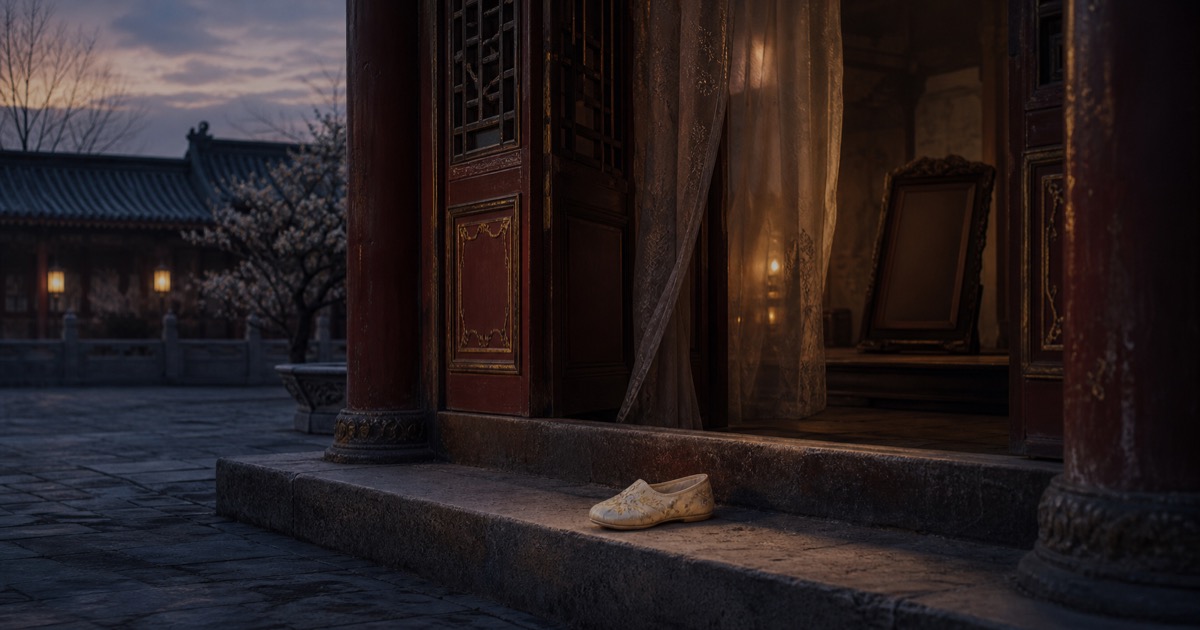
A-Shuo is the first character I wrote into The Emperor’s Caged Bride. She never speaks. She never appears in a scene. By the time the book opens she has already been dead for over a year, and I tell the reader so early in the first chapter, so the death cannot be mistaken for suspense. The story is not whether A-Shuo will live. The story is how much room she still takes up after she has been buried, how much air the people who loved her keep saving for her without quite realizing it. This piece is about that pressure — the shape an absent woman makes in a palace that has not yet learned to let her go. I want to explain how A-Shuo shapes A-Jiao’s marriage before A-Jiao has had time to say a single sentence inside it.
The strongest pressure in a palace room is sometimes the woman who is no longer in it.
What the household still does for her
When A-Jiao arrives at the Eastern Palace as the second Crown Princess, the rooms have not been emptied. They have been kept.
A-Shuo’s tea jars are still in the small cabinet beside the bed. The robes she did not wear that season are still folded in the trunk her women packed when she fell ill. The Crown Prince’s older calligraphy practice — the lines he made when she was watching — sits in a box he has not opened since her funeral. The household servants know her water temperature, her sleep hours, the way she liked her hair done when her head ached. None of that knowledge has been forgotten in the year between her death and the new bride’s arrival. It has been waiting.
A-Jiao steps into a household whose hands already know the previous wife’s body. There is nothing cruel in that on its own — it is what a year of grief looks like, kept in muscle memory. But it means that on her first morning, A-Jiao is not building a marriage from the beginning. She is being measured against routines that already exist.
A first wife who was loved (which is its own kind of cruelty)
It would be easier, in some ways, if A-Shuo had been difficult.
A difficult first wife is something a replacement can quietly improve upon. A beloved first wife is something a replacement can only fall short of. A-Shuo was the elder Cui daughter, raised for the marriage, articulate, even-tempered, well-read in the formal verse the court recited. The dowagers approved of her. The Empress respected her. The Crown Prince’s mother had begun to speak of her almost as a daughter.
A-Jiao grew up beside that legend. The two girls were cousins inside the same clan; their fathers shared a courtyard, and the two of them shared a tutor for a few seasons in girlhood. A-Jiao’s memory of A-Shuo is not the polished version the family keeps in the ancestral records. It is more ordinary: a slightly older girl who corrected her brushstrokes too patiently, who sometimes laughed at the wrong moments, who got headaches when the weather changed. That is a private memory, and the palace does not want it. The palace wants A-Jiao to honor the predecessor, not to grieve the cousin. Those are not the same act.
Three relationships A-Shuo still arranges
A-Shuo arranges A-Jiao’s marriage to the Crown Prince long after she has stopped breathing. She does it in three ways.
She arranges the Crown Prince’s gaze. He does not see A-Jiao first. He sees the absence A-Shuo left, and then the body that has been moved into it. When he is tender with A-Jiao, the tenderness was often learned on another woman. When he is unjust with her, the injustice is sometimes a complaint addressed to the woman who can no longer answer. I made the broader structural argument about love and possession in Why Palace Romance Needs Tragedy. A-Shuo’s particular weight in this novel is that she leaves him with a grief he is not equipped to face cleanly, and he turns the leftover love into pressure on the wife he has now.
She arranges the household’s expectations. The senior maids of the Eastern Palace, the matrons, the older eunuchs — they liked A-Shuo. They learned how to serve her, and they were proud of how well they did it. When A-Jiao steps in, they do not consciously punish her. They simply demonstrate, in small ways, that the previous Crown Princess had a way of doing things and the new one has not yet earned that ease. A wife who notices this can either submit to it and feel erased, or push against it and seem unfilial. Both options are wrong. That is one of the palace’s most efficient weapons: leaving a woman no clean way to be in the room.
She arranges the family’s mathematics. The Cui clan did not send A-Jiao because they wanted her there. They sent her because they could not pull A-Shuo’s coffin back out of the ground. The clan needed a daughter beside the heir, and A-Jiao was the daughter still standing. A-Shuo’s death is the unspoken first sentence of A-Jiao’s marriage contract. It is also the reason Prince Ning, whom A-Jiao loved before any of this began, becomes a man she is no longer allowed to want. A-Jiao’s quiet hiding inside duty, which I traced in the morally grey heroine piece, cannot be separated from the dead cousin whose place she was sent to fill.
What A-Jiao is not allowed to grieve
This may be the cruelest small thing in the novel.
A-Jiao did love A-Shuo, in the uneven, jealous, sisterly way that cousins in a large clan often love each other. She was angry at her sometimes. She admired her. She wished, occasionally, to be left alone by her. None of that is permitted in the marriage she enters now.
In public, she must speak of A-Shuo only as the late Crown Princess, the model she now follows. In private, in the bedchamber, she is supposed to behave as though A-Shuo were a chapter that has been closed. Neither register lets her say the true thing — that she lost her cousin, that her cousin’s death is the reason she is here, and that she does not yet know what to do with a grief she was not allowed to name on her own terms.
The official tribute eats the private mourning. That is the mechanism a palace uses to keep the household running, and the cost of that mechanism is paid in a young woman’s silence.
Why an absent woman is the strongest pressure in the room
Living women can be argued with. They age, change their minds, get tired, contradict themselves, do something embarrassing at a banquet, lose their temper in front of the wrong person. Living women can ruin their own legends.
The dead do not ruin their legends. A-Shuo cannot become difficult. She cannot disappoint anyone now. She is no longer in the room to soften, complicate, or break the version of herself her family needs. That is why a dead first wife is a more efficient pressure than a living rival — and why, in palace fiction, an absent woman so often weighs more than a present one.
The harem is full of women being watched, judged, ranked, and sometimes preserved by their own deaths into a more useful shape than they ever managed in life. A-Shuo is not unusual in this. She is the form, drawn cleanly, of something the palace does to many women.
A-Jiao cannot beat A-Shuo in the comparisons the palace stages between them, because the comparison is rigged — one of the two women cannot lose another argument, since she is not here to make one. What A-Jiao can do, slowly, is realize that the contest itself is the trap. To break the cage, she would have to refuse the comparison entirely. That refusal is the harder novel inside the novel. It is the one I tried to write under the surface of the visible plot.
A note before the next ghost
And A-Shuo is not the only ghost who shapes a Tia Shan novel. We will return to this.
There is a way, across all three books, that women who never appear — or who appear only in memory, or who appear once and then become the wound the rest of the book refers back to — exert more force on the living women than the living women can exert on each other. The shape of that absence is different in each novel, but it is the same shape. A-Shuo is the cleanest place to begin, because the entire architecture of The Emperor’s Caged Bride rests on her.
She never appeared. She shaped everything.
What to do next
If you want to read the novel, The Emperor’s Caged Bride is the closest place to begin. The Reader’s Guide has content notes if you need them first.
If you want the structural argument behind why palace fiction holds onto its ghosts, read Why Palace Romance Needs Tragedy. If you want a fuller portrait of A-Jiao herself, the piece on What Makes a Morally Grey Heroine Compelling walks through her in more detail.
A-Shuo will be back. Not in person — she has done her appearing — but in a longer essay on substitution that arrives later in this series. Until then, she will keep doing what she has been doing since the opening pages of the book: filling the rooms she can no longer enter.
— Tia
A free story for new readers
The Empress He Could Not Keep — a complete short story
of empire, obsession, and the impossible return.
Yours when you join the reader list.