The Real Empresses Behind A-Jiao, Yueying, and Changning
The historical echoes behind Tia Shan's heroines: Chen Jiao, Changmen Palace, revenge empresses, and women hidden in temples.
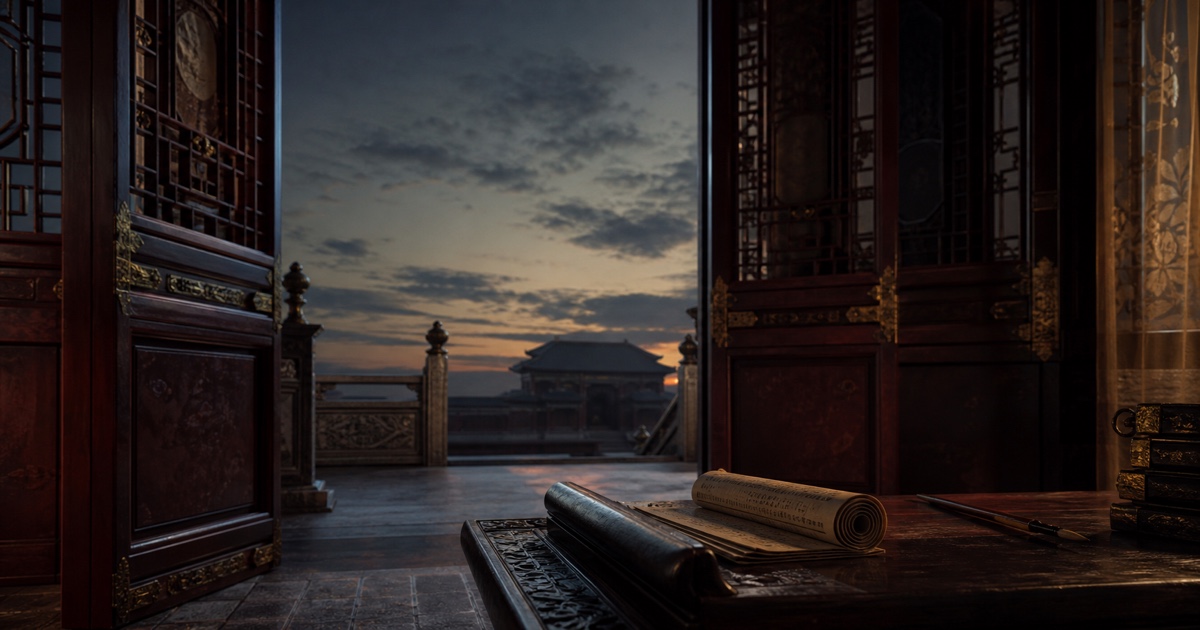
I write imagined dynasties because I do not want real women to become costumes.
That may sound strange for someone who writes palace tragedies. My books are full of emperors, empresses, consorts, clan politics, succession pressure, temples, poison, silk, and rooms where one wrong sentence can ruin a life. They are deeply shaped by Chinese imperial history. But A-Jiao, Yueying, and Changning are not one-to-one retellings of real women.
What interests me is the pressure history leaves behind: the abandoned first wife, the powerful woman later remembered as a monster, the noblewoman hidden in a religious space after politics destroys her family.
So this is not a list of “who is secretly who.” It is a map of the real historical shadows my fictional women walk past.
A-Jiao and the golden house
The most visible historical echo is A-Jiao from The Emperor’s Caged Bride.
Her name immediately calls to mind Chen Jiao, often remembered as Chen Ajiao, the first empress of Emperor Wu of Han. In later tradition, she is tied to one of the most famous romantic promises in Chinese historical memory: the young Liu Che supposedly said that if he could marry A-Jiao, he would keep her in a golden house.
It sounds like a fairy tale until you remember what a golden house is.
It is still a house.
Chen Jiao did become Empress. She also became one of the classic images of the discarded wife: high-born, politically useful, once favored, later displaced, eventually confined at Changmen Palace after she lost the emperor’s favor. The famous Changmen Fu, traditionally associated with Sima Xiangru, helped turn her into a literary archetype: the woman behind palace doors, waiting for a love that has already moved elsewhere.
That historical afterlife matters more to me than any simple biographical borrowing.
My A-Jiao is not Chen Jiao. She is a girl in an imagined dynasty, forced to marry her dead cousin’s husband because her clan still needs a daughter in that place. Her cage is built from family duty, imperial marriage, comparison to a dead woman, and a palace that teaches her to perform obedience before she understands what obedience will cost.
But the emotional shape is related: a young woman enters the center of power and discovers that honor can become confinement. A promise can become architecture. A name can become a role she did not choose.
That is why the “golden house” image is so dangerous. It turns possession into poetry. It asks the reader to admire the splendor before noticing the lock.
In The Emperor’s Caged Bride, I wanted the lock to be impossible to miss.
Yueying and the revenge-empress imagination
Ruan Yueying from The Cloud Beside the Moon does not come from one specific empress.
She belongs instead to a larger historical imagination: the powerful woman whose injury becomes strategy, whose intelligence becomes frightening, and whose eventual authority makes later storytellers argue about whether she was justified or monstrous.
Chinese history has many versions of that argument. Empress Lu, or Lü Hou, is remembered as the first woman to rule imperial China in her own right through regency, and also as a figure surrounded by stories of vengeance and cruelty. Wu Zetian is remembered as the only woman to rule China as emperor, brilliant and ruthless, endlessly reinterpreted as either political genius or moral warning.
Those women are not interchangeable. They lived in different moments, held different kinds of power, and were written into history by different political needs. But together they show a pattern that fascinates me: when a woman survives the palace well enough to command it, the story often stops asking who harmed her first.
It asks what she became afterward.
That is Yueying’s territory.
She enters the Eastern Palace as a Secondary Consort when she had every reason to expect the principal seat. That rank is not a decoration. It decides who sits above her, who can humiliate her politely, whose child will matter, and whose pain the household can ignore. Her wedding night becomes the wound the rest of the book cannot stop touching. Her friendships become loyalty, leverage, grief, and accusation. Her revenge is not a clean heroic arc. It is a long education in how power stains the hand that uses it.
This is why I think “revenge empress” is most interesting when it is not written as simple empowerment.
A crown can be a victory. It can also be evidence.
Yueying’s historical echo is not the biography of Empress Lu or Wu Zetian. It is the old discomfort around women who remember too clearly, wait too patiently, and learn the tools of the system that injured them. Readers may admire her. Readers may argue with her. I argued with her while writing her.
That argument is the point.
Changning and women hidden in temples
Ye Changning from The Emperor’s Last Lie is different again.
She does not echo one famous empress the way A-Jiao echoes Chen Jiao. Her historical resonance is more structural: noblewomen, consorts, widows, and politically dangerous women being moved into religious spaces after a death, a dynastic transition, or a family catastrophe.
In Chinese imperial history, temples and convents could be places of sincere religious life. They could also become places where a woman was made quieter.
After an emperor died, some women of the inner palace were sent out to religious institutions. In the Tang, Wu Zetian famously spent time at Ganye Temple after Emperor Taizong’s death before returning to court under Gaozong. Other women entered Buddhist or Daoist spaces for grief, widowhood, political safety, family strategy, or lack of better choices. A temple could be sanctuary, exile, storage, or all three at once.
That is the shadow behind Anyuan Temple.
When The Emperor’s Last Lie begins, Changning has spent seven years outside the palace after rebellion destroys the world she knew. The court thinks it understands her through categories: fallen family, former Crown Princess, temple woman, substitute consort, resemblance to another dead favorite. Every category is a way of reducing her before she speaks.
The temple matters because it looks peaceful from far away.
Inside the story, it is not simple peace. It is disappearance. It is survival after political ruin. It is the place where a woman can keep breathing because the world has decided she is no longer useful in public.
Even Changning’s name carries that ache. “Changning” suggests lasting peace, but peace in palace fiction is rarely a gift. Sometimes it is a name given to a life that has already been stripped down to endurance.
This is also why Changning became the strongest bridge from The Story of Ming Lan into my books. She is not loud about her intelligence. She watches. She measures danger. She knows that family history is never safely past, because the court keeps turning old blood into present leverage. If you came here from Ming Lan, I wrote a deeper reading path in this earlier post.
Her historical echo is the woman who has been removed from the official room, but not from history’s consequences.
Why the books are imagined, not disguised history
If you know the real stories of Chen Jiao, Empress Lu, Wu Zetian, or palace women sent into religious life, you will feel traces of them in my books.
But traces are not chains.
I write imagined dynasties because I want room to follow emotional truth without pretending I am reconstructing one official biography. Real history is not a basket of plot twists to steal from. It is a field of pressure: rank, clan duty, succession, reputation, pregnancy, mourning, ritual, and the terrifying fact that a woman’s private life could become state business.
Fiction lets me ask what that pressure feels like from inside the room.
A-Jiao asks what happens when a girl is made into a replacement before she has finished becoming herself.
Yueying asks what happens when revenge succeeds, but the soul keeps the receipt.
Changning asks what happens when survival depends on disappearing, and love returns wearing the face of danger.
None of them is a real empress in a thin veil. All three are fictional women walking through emotional architecture that history made recognizable.
Where to start
If Chen Jiao and the image of Changmen Palace interest you, start with The Emperor’s Caged Bride. It is the most direct conversation with the abandoned-empress archetype: golden cage, replacement bride, dead first wife, and imperial love as possession.
If you are drawn to the darker question of women, power, and revenge, start with The Cloud Beside the Moon. Yueying is for readers who want moral complexity more than comfort.
If the temple exile, fallen family, and substitute-consort shape is the one that caught your attention, start with The Emperor’s Last Lie. Changning’s story is palace mystery wrapped around childhood love, political ruin, and the cost of surviving under the wrong name.
For a broader map of the tropes, read Chinese Historical Romance Tropes, Explained Through Tia Shan’s Books. For content notes and reading order, use the Reader’s Guide.
And if you want the shortest way into the palace, browse all three books.
The dynasties are imagined.
The locks are not.
— Tia
A free story for new readers
The Empress He Could Not Keep — a complete short story
of empire, obsession, and the impossible return.
Yours when you join the reader list.