Why The Cloud Beside the Moon Is Not a Romance
A spoiler-light guide to why The Cloud Beside the Moon centers trauma, revenge, and moral cost more than romantic redemption.
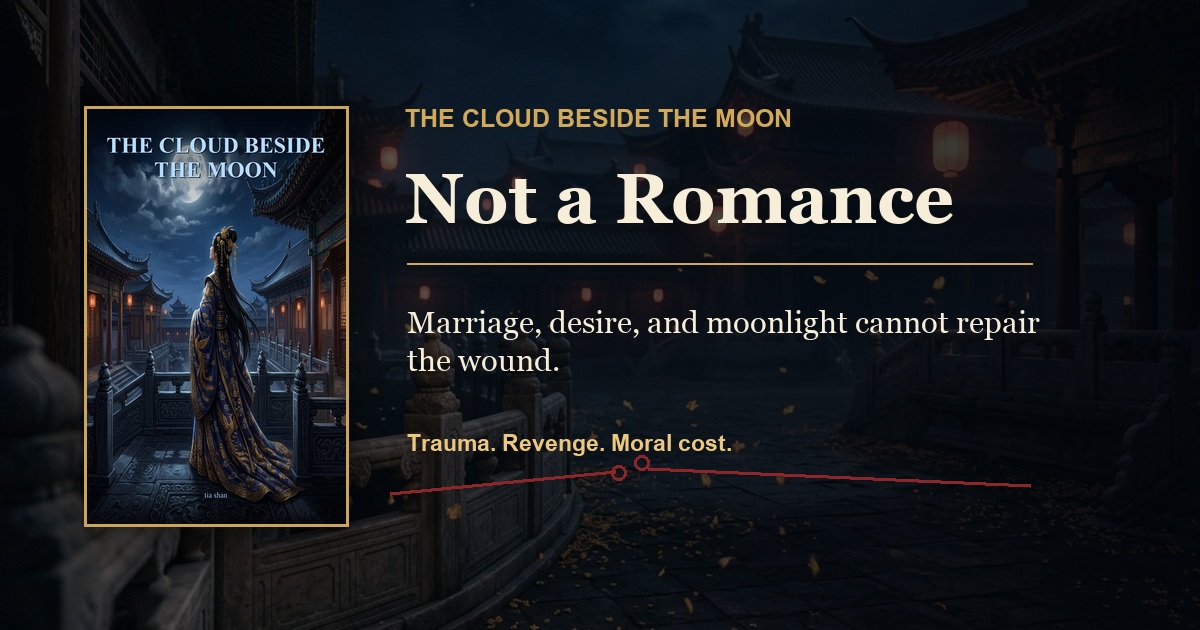
I understand why The Cloud Beside the Moon looks, at first glance, like a romance. There is a marriage. There is a handsome Crown Prince. There is jealousy, desire, rivalry, a heroine who becomes Empress, and one moonlit scene where the life they might have had almost steps into the room. But a romance is not simply a story where two people are bound together by longing. A romance is a promise about what that longing finally means. This book refuses that promise. It lets love appear, but it does not make love the cure. The center of Yueying’s story is not whether she can soften toward her husband. It is what she must do with a wound the palace keeps asking her to swallow.
Content note: this essay discusses marital sexual assault, grief, child loss, death in childbirth, and revenge. Spoiler level is medium. I talk about the shape of the novel, but I do not quote the final scene.
Marriage is the setting, not the promise
In a conventional romance, marriage often functions as a problem that can become a home. Two people are mismatched, wounded, proud, politically entangled, or forced together too soon, and the pleasure of the genre is watching “we must share a life” become “we choose each other.” Yueying’s marriage does not move that way.
She enters the Eastern Palace as a Secondary Consort, not the Crown Princess she might once have expected to be. Before love is even possible, rank has already told her what she is worth. Then the wedding night destroys the last illusion that this arrangement can be treated as ordinary. The Crown Prince comes to her drunk, entitled, and careless with a dignity he does not understand he is taking from her.
The plot contains later tenderness. The Emperor can be gentle. He can apologize. He can look at Yueying as if he finally understands that she is not merely a household duty or a political convenience. But tenderness after harm is not the same thing as repair. An apology does not erase the first night. A shared child does not turn violation into destiny. A palace marriage can produce companionship, habit, heirs, and public harmony without ever becoming a true romance.
That is the first rule of the book: being married is not the same as being safe.
Desire is treated as pressure
The book is full of desire, but almost none of it is free.
Hu Mianmian desires the Crown Prince with a bright, innocent intensity that the palace has no room for. Qin Yunnong desires love, legitimacy, security, and the right to remain first in a household where every woman’s body can become a political threat. The Crown Prince desires comfort without consequence. Yueying desires distance, dignity, justice, and later the impossible luxury of not calculating every feeling before she has it.
That is not the emotional economy of a romance. It is the emotional economy of a palace. Desire does not simply reveal the heart. It creates leverage: visits, pregnancies, sickbeds, rank, household authority, and the ability to make generosity look harmless until it closes around someone.
This is why Mianmian’s arc is so important. Her feeling is real, but it is also usable. Once a palace learns where a woman is soft, that softness can be pressed until it bruises. I wrote more about her promise in The Meaning of the Moon and Cloud, because after Mianmian, no one can pretend the palace is merely a stage for longing.
Revenge is not foreplay
There is a familiar dark-romance rhythm where cruelty, jealousy, and revenge become part of the couple’s heat.
That is not what happens to Yueying.
Her revenge does not exist to make the Emperor want her more, or to make her eventual surrender feel more intense. It exists because she has learned that innocence does not survive by remaining innocent. After Mianmian’s death, Yueying begins using the same tools the palace has used against her: timing, performance, illness, rank, household authority, motherhood, mourning, and the careful placement of words.
But it also gives the book its moral cost. Yueying does not become powerful without becoming implicated. The harder question is what happens when justice begins to resemble the harm that taught it how to move. She wins ground, protects children, and learns to govern a household and later a harem. She also has to live with the knowledge that her hands are no longer clean.
I wrote about the twenty-year shape of that revenge in Twenty Years of Revenge, but the shorter version is this: the revenge is not a romantic obstacle. It is the spine of the novel. The marriage bends around it, not the other way around.
The almost-love scene is not a redemption arc
There is one scene I think romance readers may feel most sharply: the moonlit almost.
Yueying has gained rank and lost things that cannot be returned. In a quiet hall under moonlight, she looks at the Emperor and sees, for a moment, the man he might have been if history had been kinder and he had been braver.
And then she refuses it.
If the story were built around romantic redemption, this would be the turning point. The heroine would recognize the hidden softness beneath the flawed man, and the past would become survivable through love. Yueying cannot accept that bargain. To love him fully would require her to pretend the humiliation at the beginning can be absorbed into the tenderness that arrives later.
She will not do it. She refuses to become the kind of woman who calls compromise healing just because the man has finally learned to be gentle.
That is why the moonlit scene hurts. It proves love is possible, then proves possibility is not enough.
The moral cost matters more than couple resolution
Romance asks, in some form: can these two people make a life together?
The Cloud Beside the Moon asks a colder question: what does a woman become when the life she has to survive keeps rewarding the parts of her she fears most?
Yueying’s public life can look like victory. She gains status, influence, children, and indispensability. From outside the palace, people can read her story as triumph: the Secondary Consort who rose, the Empress who held the harem steady.
But the novel is not satisfied by that public version.
It keeps returning to private cost. Mianmian is gone. Qin Yunnong is gone. Wen Shuer’s loyalty carries its own hidden stain. Children become love, legacy, punishment, and terror. Even the palace’s quieter years are years of performance, where Yueying learns to act the wife so well that the difference between survival and surrender begins to blur.
This is where the book becomes most tragic. It does not say Yueying should have forgiven more easily, or that revenge was wrong in some simple moralistic way. It says a palace can make every available choice costly. If she does nothing, she is used. If she fights, she is changed. If she loves, she risks betraying the dignity that kept her alive.
No romance contract can solve that. The damage is not a misunderstanding. It is a structure.
So what kind of book is it?
I still use phrases like “palace romance” carefully because they help readers find the shelf. There is no clean English label for this tradition of Chinese palace angst: marriage, hierarchy, harem politics, female rivalry, impossible tenderness, and tragedy that feels emotionally earned.
But if you are asking what kind of reading experience The Cloud Beside the Moon offers, I would call it a palace tragedy built around revenge, female friendship, and moral reckoning.
Read it if you want a proud, wounded, severe heroine and a victory that keeps asking whether winning has saved anything essential. Do not read it expecting a wounded husband to be redeemed by patience, a wedding to become a cure, or a final confession to make the past gentle. The romance is one possible road the characters missed. The tragedy is the road they actually walked.
What to do next
If that is the kind of pain you came for, start with The Cloud Beside the Moon. It is available on Kindle and Kindle Unlimited.
If you want content notes first, read the Reader’s Guide. If you want a broader map of how this book sits beside A-Jiao’s slow heartbreak and Changning’s palace mystery, read Three Books, Three Palaces.
The book is not asking whether love can make the wound beautiful. It is asking what remains when it cannot.
Tia
A free story for new readers
The Empress He Could Not Keep — a complete short story
of empire, obsession, and the impossible return.
Yours when you join the reader list.