What Imperial Favor Buys—and Why It Never Makes a Palace Woman Safe
In Tia Shan's palace tragedies, imperial favor buys silk, rank, doctors, and enemies—but never the right to feel safe.
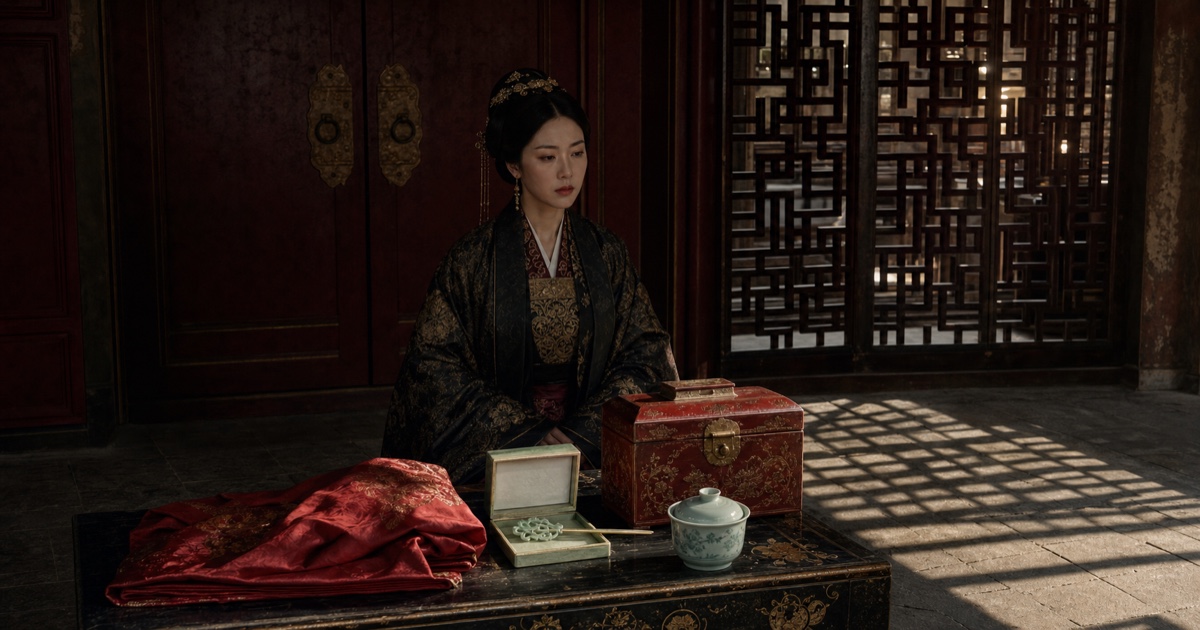
Every palace story eventually begins counting nights. Which lamp stayed lit? Which courtyard received a tray of gifts at dawn? Which woman suddenly has better charcoal, quicker access to a physician, and six new enemies before breakfast? I write a great deal about imperial favor, but I rarely mean romance when I use the phrase. Favor is a delivery system. It moves silk, medicine, rank, servants, information, and danger from the Emperor’s hand to a woman’s door. The jade hairpin is real. So is the guard who suddenly cannot hear her once the Emperor stops visiting. Across my three novels, favor can make a woman powerful for an evening. It never makes the power hers.
Spoiler level: light to medium. This essay discusses palace dynamics and early-to-middle plot developments in all three books, but it does not reveal the endings.
Favor is a public event
Imperial affection has terrible privacy.
The Emperor may whisper in a bedchamber, but the whole palace reads the visit by morning. Eunuchs record where he slept. Servants carry away untouched dishes. Physicians notice whose pulse they are summoned to take. Ministers count pregnancies. Families outside the walls hear of gifts and begin making plans.
That is why favor in palace fiction behaves less like a private feeling and more like a change in the weather. A warm front reaches one courtyard; every other courtyard adjusts.
The practical benefits are substantial. A favored woman may receive rare fabric, jewels, a larger household, a promotion, better food, warmer rooms, and an Emperor willing to listen when she names an enemy. Her relatives may gain appointments. Her servants stop being shoved aside in corridors. If she falls ill, the Imperial Medical Bureau remembers how quickly feet can move.
The price is visibility. A woman who receives something valuable becomes a woman worth watching.
A-Jiao has the title and loses the door
In The Emperor’s Caged Bride, A-Jiao is taught early that favor must be kept. Her aunt, the reigning Empress, speaks of it almost as family property: one Cui woman carries imperial affection now; another must carry it later. Favor is expected to protect the clan after rank and seniority are no longer enough.
A-Jiao eventually becomes Empress. She lives in Weiyang Palace and holds the phoenix seal. On paper, there is no woman above her.
Then the Emperor withdraws his recognition.
The change is brutally ordinary. A title remains embroidered on her robes, yet palace servants learn that ignoring her will not be punished. Guards can close a path. Physicians can decide that another patient is more urgent. When A-Jiao tries to obtain treatment for Consort Dowager Xu, the problem is not that she lacks ceremonial authority. The problem is that everyone knows whose displeasure matters more.
Rank tells the palace how deeply to bow. Favor tells it whether the bow needs to mean anything.
That gap is the lock on Weiyang Palace’s golden cage. A-Jiao owns the correct seal. She does not own the hands required to obey it.
In Yueying’s palace, a pregnancy changes the ledger
The Cloud Beside the Moon begins with Qin Yunnong holding nearly every scrap of the Crown Prince’s affection. He insists on making a woman from a modest official family his principal wife, pushing the better-born Yueying into the position of Secondary Consort. Love appears to have defeated pedigree.
It has not abolished pedigree. Yunnong’s lower birth remains a subject for the household to discuss, and her failure to conceive quickly becomes public pressure. The more obviously the Crown Prince loves her, the more closely everyone studies what that love has failed to produce.
Then Yueying becomes pregnant after one terrible wedding night.
Tonics arrive. Rewards arrive. The Crown Prince arrives, carrying an apology that he expects to be received more gratefully than it is. Yueying does not want his favor; she wants enough distance to raise her child in peace. The palace cannot understand that preference. Pregnancy has converted her body into dynastic value, so the household treats attention as a blessing even when the woman receiving it would rather the gifts came without the man attached.
That distinction sits beneath the whole book. Favor can provide material care while making emotional harm harder to name. A well-stocked medicine cabinet does not settle whether a woman was wronged. A generous stipend does not turn access to her body into tenderness. I wrote more about that false equation in Why The Cloud Beside the Moon Is Not a Romance.
The favorite becomes the clearest target
The Emperor’s Last Lie contains the sharpest example of favor’s spotlight.
Imperial Noble Consort Lin rises at astonishing speed. Li Chengmu refuses to give her a prefixed title because, in his mind, there should be no second Noble Consort with whom she might be confused. He pushes her toward the authority of an Empress. Everyone knows she is loved.
Everyone also knows precisely where to strike him.
After her death, the palace does not become free of that favor. Li Chengmu keeps searching for her face in other women. The replacements inherit attention without inheriting the relationship they are meant to resemble. A dead favorite continues rearranging living bodies.
Consort Rong chooses another strategy. She makes imperial indulgence noisy, using each forgiven offense to teach the palace that retaliation will not come. Her protection works until it collides with a grief or political calculation deeper than indulgence.
Consort Wan goes the other way. She has rank but almost no visible favor, so the ambitious women stop counting her. From her sickbed she watches, remembers, and interferes when she chooses. Her apparent irrelevance gives her room that the favorites do not have. Her cinnabar handkerchief is funny, but the joke rests on a serious calculation: a woman nobody envies can leave the room alive.
A medicine bowl is never just a medicine bowl
Palace wealth creates the illusion that everyone inside receives magnificent care. The shelves are full of rare herbs. The physicians have impressive titles. Porcelain bowls arrive on lacquer trays.
None of that answers the useful question: who ordered the bowl delivered?
Medical attention follows political attention. A favored pregnancy receives constant pulse checks. A disgraced woman may wait while an official explains protocol. A diagnosis can be softened, hidden, delayed, or turned into evidence. Even a truthful physician works inside a system where the ruler decides which truth will have consequences.
The same applies to food, charcoal, servants, and messages. Palace danger often looks less like an assassin and more like an ordinary service becoming mysteriously slow.
That is one reason I keep returning to household details. Grand decrees tell us who supposedly holds power. A cold brazier tells us whether that power reached the room.
Why seek favor at all?
Given all this, it would be easy to treat women who pursue imperial favor as vain or foolish. I do not.
When one man’s attention controls warmth, medicine, children, family safety, and whether servants obey, seeking that attention may be plain risk management. A consort can dislike the Emperor and still need him to visit. She can despise the competition and still understand that losing publicly will cost more than pride. She may be trying to keep a brother employed, a daughter near her, or a maid out of the punishment bureau.
Some women want love. Some want status. Most want several things at once, because people are inconvenient that way.
The palace’s cruelest trick is making those wants look identical from outside. Every woman walks toward the same lit doorway. No observer can tell whether she hopes to be kissed, heard, promoted, spared, or simply warm for one more winter.
The gift belongs to him until she can keep it without him
Imperial favor buys real things. My characters are not wrong to count them. Silk has value. A physician arriving on time has value. A rank that protects a child has enormous value.
Safety requires something favor cannot provide: power that continues after the Emperor changes his mind.
Very few palace women ever receive that. They borrow authority from his desire, then discover the loan can be recalled without notice. The box remains lacquered. The jade remains beautiful. The door closes just as firmly.
If the court ranks and household offices are unfamiliar, the Palace Titles Guide explains the formal hierarchy. For the difference between dangerous love and a dark-romance promise, read Are My Books Dark Romance? Here’s the Honest Answer. The Complete Reader Companion gathers the spoiler essays and character studies for all three books.
Or choose a palace and begin with one of the novels. Just remember to watch who receives the medicine—and who controls the door.
— Tia
A free story for new readers
The Empress He Could Not Keep — a complete short story
of empire, obsession, and the impossible return.
Yours when you join the reader list.